

With the Wild Things
Weekdays @ 7:20 AM

With the Wild Things is a one-minute look at a particular environmental theme hosted by wildlife biologist Dr. Jerry Jackson. Produced by WGCU Public Media. Dr. Jackson takes you through your backyard, and Southwest Florida’s beaches, swamps and preserves to learn about “the wild things”.
With the Wild Things was previously funded by the Environmental Education Grant Program of the Florida Fish and Wildlife Conservation Commission.
Latest Episodes
-
 White Ibises are common birds of Florida wetlands that increase in numbers with arrival of migrants from more northern areas. While they normally feed in shallow water, they have also become birds of grassy areas such as our yards, parks, and highway and canal rights-of-way. Adults have white plumage with only the tips of outer primaries black -- a characteristic that reduces wear of those feathers. Sex of adults is often easy to distinguish when the birds are in a group. Males are larger with a longer, straighter (but still curved) bill.Females are smaller with a shorter, often more-curved bill. Young White Ibises always have white on their underparts, but recent fledglings can be almost all gray-brown. Over their first year the more-gray plumage is replaced by brown and then gradually changes to the white of an adult. Through much of the year the legs, bill, and face of a White Ibis is flesh-colored or pink, but as nesting approaches the bill, face, and legs become vibrant red. Both sexes have beautiful light blue eyes.
 -
 With its all-white plumage, black bill, black legs, and bright yellow face and feet, the Snowy Egret is a stunning and easily recognized bird – one that I often refer to as the “bird with the golden slippers.”So why does the Snowy Egret have yellow feet? Perhaps to keep it from stabbing its own feet as it searches for the small creatures it eats. The intensity of the yellow on both its face and its feet becomes brightest during the breeding season, thus it probably also plays a role in courtship – perhaps serving as an indicator of the health of the bird.
 -
 What’s in a name?If it’s the name of the Florida Red-bellied Cooter, there’s a lot! This freshwater (and occasionally brackish water) turtle is found in calm water through most of Florida and into southern Georgia. “Red-bellied” describes most young adults, but as they age, their belly changes color and can be brown or yellow.And that name “cooter” – where did it come from and what does it mean? The name “cooter” is centuries old and it seems likely that it was the name used by slaves from west Africa. In their language, the name for turtle – is today spelled “kuta” and pronounced like “cooter.
 -
 Blue crabs are familiar to most beach goers because of the telltale blue on their legs – and to most seafood aficionados because of their luscious taste and prominence on seafood menus. While they are found over a wide span of warm near-shore seawaters, they are particularly abundant in Florida. On this week’s “Wild Things” I’ll focus on their seasonal movements, their longevity, their mating behavior, their swimming abilities, and the rapidity with which they can hide from a predator by backing into soft sand or mud to escape a potential predator.
 -
 The Loggerhead Shrike is found in Florida year-round, but reaches its peak abundance in mid-winter with the arrival of more-northern migrant birds.Shrikes feed extensively on insects, small mammals, birds, reptiles and other prey that they capture on or near the ground. As snow begins to cover the ground to the north, shrikes head south – joining the human “snowbirds” and our resident non-migratory population of shrikes.Little is known of interactions between the migrant and the resident shrike populations – providing a difficult, probably long-term, research opportunity. Both resident and migrant shrikes occupy open habitats both in cities and in the country-side.Roadsides with close-cropped vegetation and bordering fences are favored sites because of the presence of road-killed or injured animals and the ease of seeing animals crossing the road.Their flight in pursuit of prey is often within 3-4 feet of the ground. This, of course also makes shrikes vulnerable to getting hit on the road. Thus far Loggerhead Shrikes remain across their continent-wide range, but they also remain very vulnerable.
 -
 Pigeons and Doves are members of the same family – Columbidae – and the names “pigeon” and “dove” have little relevance. Those we call “pigeons” are generally larger than those we call doves. Pigeons and doves occur on every continent and many islands and about 300 living species of pigeons and doves are known.Seven species are regularly found in Florida -- five are native; two are introduced. Others are occasionally seen. One – the Passenger Pigeon – was known from Florida, but now extinct.
 -
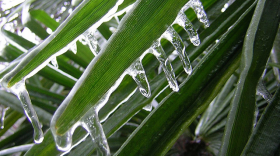 Animals in south Florida don’t have to worry much about winter cold – and indeed many migrants from areas farther north find suitable living conditions here. But, a trip to the beach or on a rare blustery day sometimes makes one wonder. How do ducks, herons, egrets, and other birds tolerate wading or swimming in cold weather? Aquatic birds, for example, have bare skinny legs with leg muscles placed among insulating feathers.Blood vessels going to and from the very few muscles in the legs and feet lie right next to one another, and cold blood going back into the body is warmed by warmer blood coming from the body – and is nearly the same temperature as the blood circulating in the well-insulated body.
 -
-
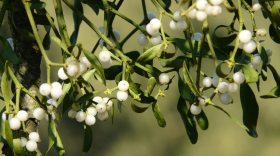
 If asked “What plant best symbolizes the winter season?”, most people might say “Christmas trees”, but a fair number might instead suggest holly. Several species of holly are native to North America. Most are evergreen, have thick, somewhat shiny leaves that are resistant to colder climates, and are bordered and tipped with sharp points that protect the leaves from winter plant “munchers”, and in winter bear small red fruits that add to their winter holiday appeal. The fruits are eaten by many bird species and the seeds inside the fruits are deposited with a bit of fertilizer to begin growth in the spring. Some holly species grow into large trees.
 -
 New World Warblers are often referred to as the “butterflies of the bird world” – a designation because of their small size and diverse colors and patterns. A few warblers nest in south Florida, but several -- including the Palm Warbler, Yellow-rumped Warbler, and Black-and-white Warbler are common winter residents.These three have distinctive plumage patterns and behaviors, making them a great trio to begin exploring the diversity of warblers that pass through on migration. Beware, however: watching warblers as they flit among the branches of tall trees in search of insects can be addictive – and lead to a temporary affliction commonly known among birders as “warbler neck”.


